

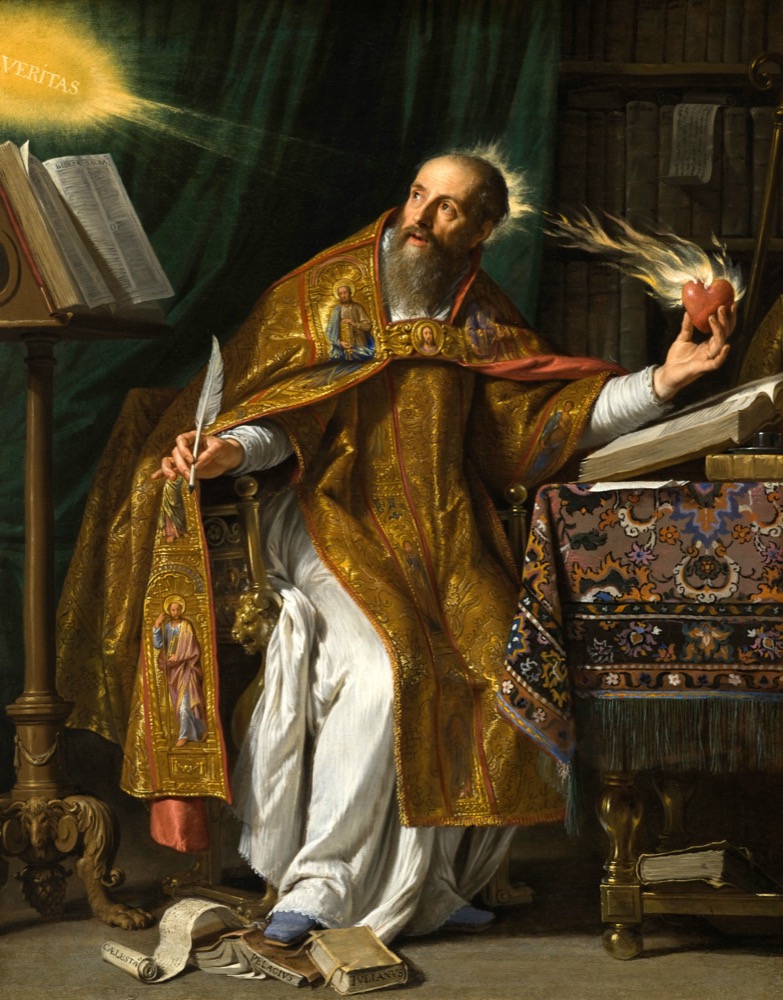
St. Augustine of Hippo
4th–5th Century · Doctor of the Church · Source of our motto
"You have made us for yourself, O Lord, and our heart is restless until it rests in you."
The Doctor of Grace
Saint Augustine of Hippo (354–430) is one of the four original Doctors of the Western Church. Born in Roman North Africa, he spent his early years pursuing pleasure, ambition, and the heretical Manichaean philosophy that taught the body was evil. His mother, Saint Monica, prayed for his conversion for nearly thirty years.
Her prayers were answered. Augustine’s encounter with the Gospel — chronicled in his Confessions, one of the most influential autobiographies ever written — transformed him into the bishop of Hippo and the theologian whose work would shape the next sixteen centuries of Christian thought.
Why the body matters to him
Augustine’s most lasting contribution to Christian anthropology is his rejection of dualism — the idea that the soul is good and the body is evil, that salvation is escape from the flesh.
He had once believed it. Then he encountered the doctrine of the Incarnation: that God himself took on a human body in Jesus Christ. If the Word truly became flesh, then flesh cannot be evil. The body is part of who you are, not a prison you are trapped in.
This is why Augustine matters to Health in the Spirit. He is the patristic theologian who articulated, with permanent clarity, that body and soul together constitute the human person — that caring for the body is caring for the human being God created and Christ redeemed.
Our motto
The motto of this podcast — “Take care of your body as if you were going to live forever; take care of your soul as if you were going to die tomorrow” — is traditionally attributed to St. Augustine.
We say traditionally attributed because the exact source is debated by scholars. But the spirit of the saying is unmistakably Augustinian. It encodes his entire theology of the human person:
- The body is good and worth tending well — because Christ took on a body and rose with it.
- The soul is the eternal one — and its readiness for God is what most urgently matters.
- Both deserve disciplined attention — not as competitors, but as the two parts of the one person you are.
The flaming heart
The iconographic symbol of Augustine is a heart in flames — sometimes pierced by an arrow, sometimes held in his hand, always burning. It represents his most famous prayer: “You have made us for yourself, O Lord, and our heart is restless until it rests in you.”
You will see this image woven into our brand — the gold-and-terracotta accent that anchors our visual identity. It is a reminder that the goal of all this work — the eating well, the sleeping well, the discipline and the intercession — is not health for its own sake. It is the soul finally at rest in God.
Why he guides us
Because Augustine refused to dismiss the body as something to escape, and he refused to let the soul be neglected. He held them together with the rigor of a philosopher and the warmth of a pastor.
For Health in the Spirit, he is the theologian who proves that integrating body-care and soul-care is not new, not trendy, not optional. It is the patrimony of the Church.
"Take care of your body as if you were going to live forever, and take care of your soul as if you were going to die tomorrow."
Traditionally attributed to St. Augustine of Hippo. It is also our motto.