

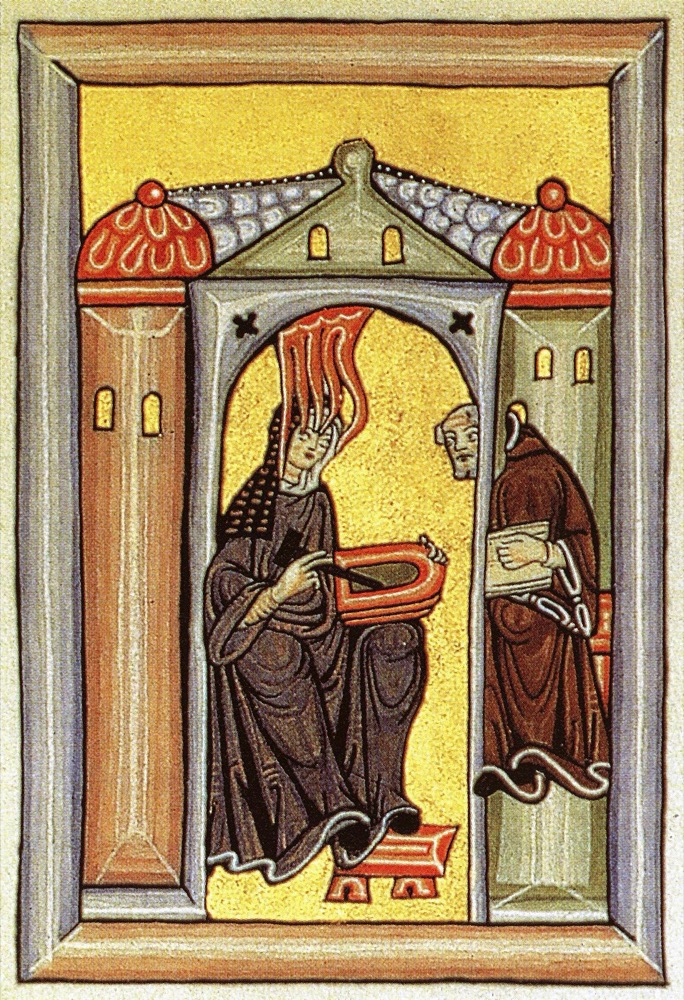
St. Hildegard of Bingen
12th Century · Doctor of the Church · Benedictine abbess · Herbalist · Mystic
"I am the fiery life of the essence of God."
The Sybil of the Rhine
St. Hildegard of Bingen (c. 1098–1179) is one of the most extraordinary figures in the history of the Catholic Church. A Benedictine abbess, polymath, mystic, composer, philosopher, and medical writer, she was named a Doctor of the Church by Pope Benedict XVI in 2012.
For a show that brings holistic health and Christian faith back into one conversation, Hildegard is the ultimate guide. She lived the reality that physical health and spiritual vitality are inextricably linked — and she wrote the medical and theological works to prove it.
Visions, music, and the courage to write
Born into a noble family in the Holy Roman Empire, Hildegard was a sickly child who began experiencing visions of “The Shade of the Living Light” from the age of three. Placed as an oblate at the Benedictine monastery of Disibodenberg, she eventually became magistra (mother superior), founded two of her own monasteries, and corresponded with popes, kings, and bishops across Europe.
Her visions were not ecstatic trances. She experienced them while fully awake, perceiving them “in my soul alone, while my outward eyes are open.” For decades she kept them secret. At forty-two, terrified of public opinion, she received a vision instructing her to “write down that which you see and hear.” She refused — and fell violently ill. Only when she finally began to write did her physical strength return.
Her major theological works — Scivias, Liber Vitae Meritorum, and Liber Divinorum Operum — received papal approval and shaped Western theology. Her music — soaring chants like O viridissima virga — is still recorded and performed today.
Physica, Causae et Curae, and Viriditas
Hildegard’s medical writings are what make her uniquely suited for Health in the Spirit. She did not claim her medical knowledge came from visions — instead, it sprang from running the monastery’s infirmary and herbal garden, combined with extensive reading.
She authored two major medical texts:
- Physica — a nine-book catalog of the scientific and medicinal properties of plants, stones, fish, reptiles, and animals.
- Causae et Curae — an exploration of the human body, its connections to the natural world, and the causes and cures of diseases.
The cornerstone of her medical and spiritual philosophy is viriditas — a Latin word she coined that translates roughly to “greening power” or “greenness.”
- Physically, viriditas is the vital life force — the vigor, freshness, and moisture that sustains health. It is the healing power of nature.
- Spiritually, viriditas is the “greening power of God” — the creative life of the Holy Spirit working within the soul.
Hildegard saw human healing as analogous to the regenerating capability of plant life. She named the opposite force ariditas: dryness, barrenness, infection. Physical disease and spiritual decay were both evidence of a blocked flow of viriditas — a withering of the green.
This is the medieval Catholic equivalent of holistic, root-cause medicine. Disease is not just a symptom to suppress; it is a sign of imbalance to be corrected by restoring the body’s God-given homeostasis.
Why she guides us
Because Hildegard refused to separate the physical from the spiritual. She understood that the same God who designed the cosmos also designed the intricate workings of the human body — that the green health of the natural world and the holistic health of the human person are intimately connected.
She is the witness that Christian tradition has always celebrated the healing power of nature as a direct reflection of the Holy Spirit’s life-giving grace.
Hildegard, in their own words
"The soul is the greening life force of the flesh, for the body grows and prospers through her, just as the earth becomes fruitful when it is moistened. The soul keeps the body alive."
"Humanity, take a good look at yourself. Inside, you've got heaven and earth, and all of creation. You're a world — everything is hidden in you."
"I am the fiery life of the essence of God; I am the flame above the beauty in the fields; I shine in the waters; I burn in the sun, the moon, and the stars. And with the airy wind, I quicken all things vitally by an unseen, all-sustaining life."
"Glance at the sun. See the moon and the stars. Gaze at the beauty of the Earth's greenings. Now, think. What delight God gives to humankind with all these things... All nature is at the disposal of humankind. We are to work with it. For without it we cannot survive."
"Dare to declare who you are. It is not far from the shores of silence to the boundaries of speech. The path is not long, but the way is deep."